

Financials that already know what’s closing and what’s shipped.
Invoices, payments, expenses, and forecasting that live on the same graph as your deals and projects. AI agents draft invoices when work completes and flag at-risk revenue before close.
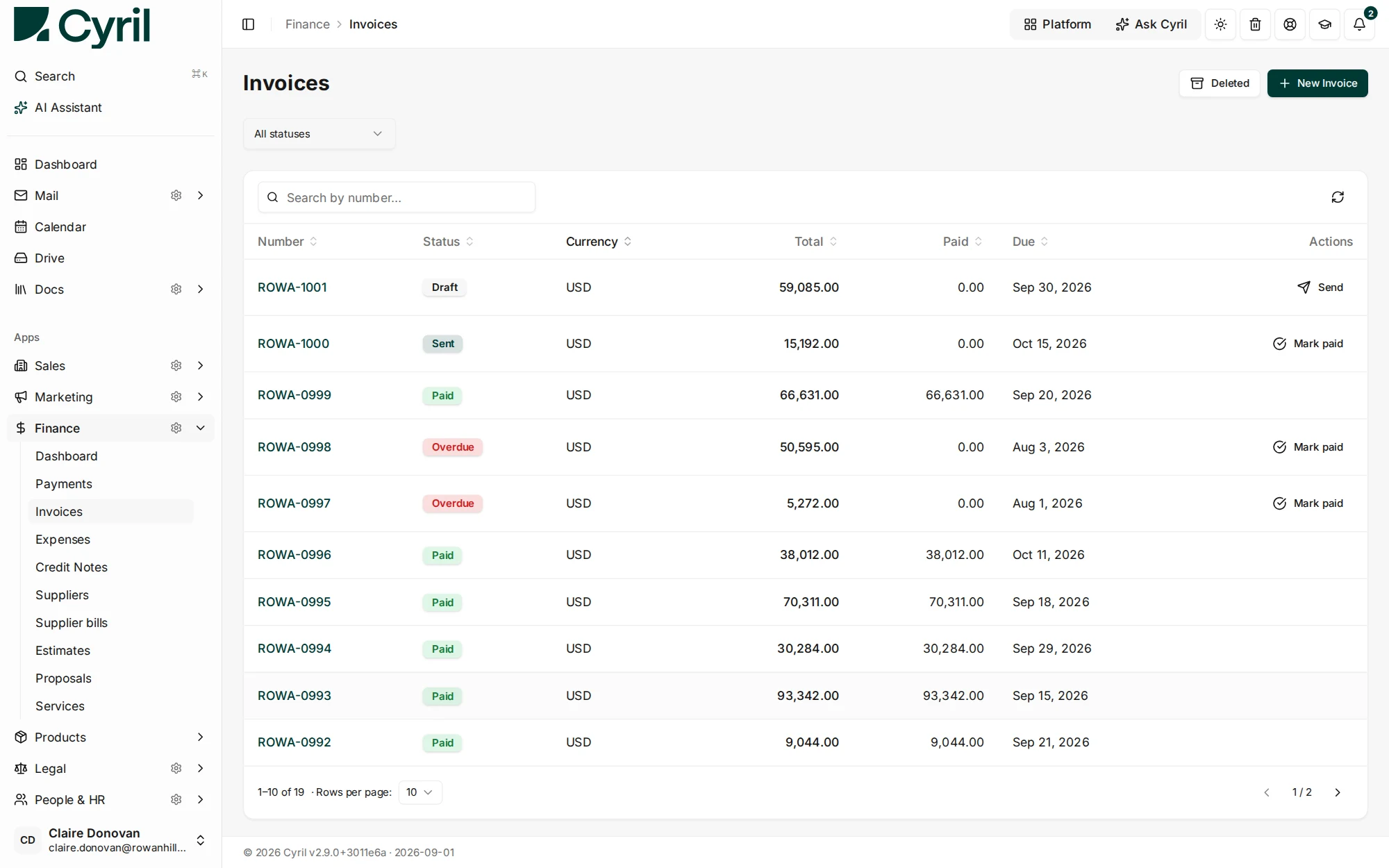
What Financials does for you
Invoicing + payments
Multi-currency invoicing with Stripe and Revolut for collection. Customer portal lets clients pay without leaving Cyril.
Expenses + receipts
Expense capture with receipt OCR. Categorisation tied to projects, departments, and tax codes for export.
AI revenue forecasting
Pipeline + project status + historical close rates → a forecast that gets better as your data does. Agents flag forecast risks the moment they appear.
Audit-ready exports
CSV / Xero / accountant-friendly exports. Full audit trail per record. SOC 2 controls applied to financial data.
Invoices that draft themselves when projects ship.
Project closes a milestone → Cyril drafts the invoice with the right line items, the right tax, and the right contact — ready for human review. No re-keying from the project tool into the finance tool.
- Milestone complete → invoice drafted
- Payment received → deal won updated
- Expense logged → project margin recalculated
Every figure can be traced back to the record it came from.
Because invoicing and forecasting read from deals and projects rather than from an import, each number has a provenance you can follow — this invoice from that milestone, this forecast from those close rates. Every record carries a full audit trail, and exports are shaped for your accountant rather than for us.
- Invoice back to milestone, forecast back to pipeline
- Full audit trail per record, on the same log as everything else
- CSV and accountant-friendly exports, always free to take
Expenses land against the project that incurred them.
Expense capture reads receipts rather than asking someone to retype them, and categorisation is tied to the project, the department and the tax code it belongs to — which is what makes an export useful to an accountant rather than a pile of lines they have to allocate. Because the project is on the same graph, a logged expense moves that project’s margin immediately instead of at month end.
- Receipt capture, categorised to project, department and tax code
- Margin recalculates on the project, not in a spreadsheet later
- Exports arrive pre-allocated, which is the part accountants charge for
Common Financials questions
For invoicing, payment capture, and expense tracking — yes. For statutory accounting (general ledger, audits, tax filing) — not at launch. Cyril exports to your accountant’s tools cleanly.
They pay through the client portal, which is free and unlimited for customer users, so there is no seat cost attached to getting paid. Multi-currency invoicing is supported with payment collection through the providers named on this page.
Less reconciliation than a two-system setup, because there is no second copy of the customer to disagree with. What does not disappear is your accountant’s process — statutory work stays with them, and the export exists for that handover.
Not beyond straightforward invoicing and forecasting. Deferred revenue schedules and multi-entity consolidation are not things to plan around today — if you need either, treat them as absent rather than coming.
Be one of the first to use Cyril.
Join the waitlist for early access. We'll only email you when there's something real to share.