

Project management for teams that already use the rest of Cyril.
Tasks, projects, milestones, and timelines that belong to the accounts, deals, and tickets you already manage. AI agents schedule, route, and close work across the graph.
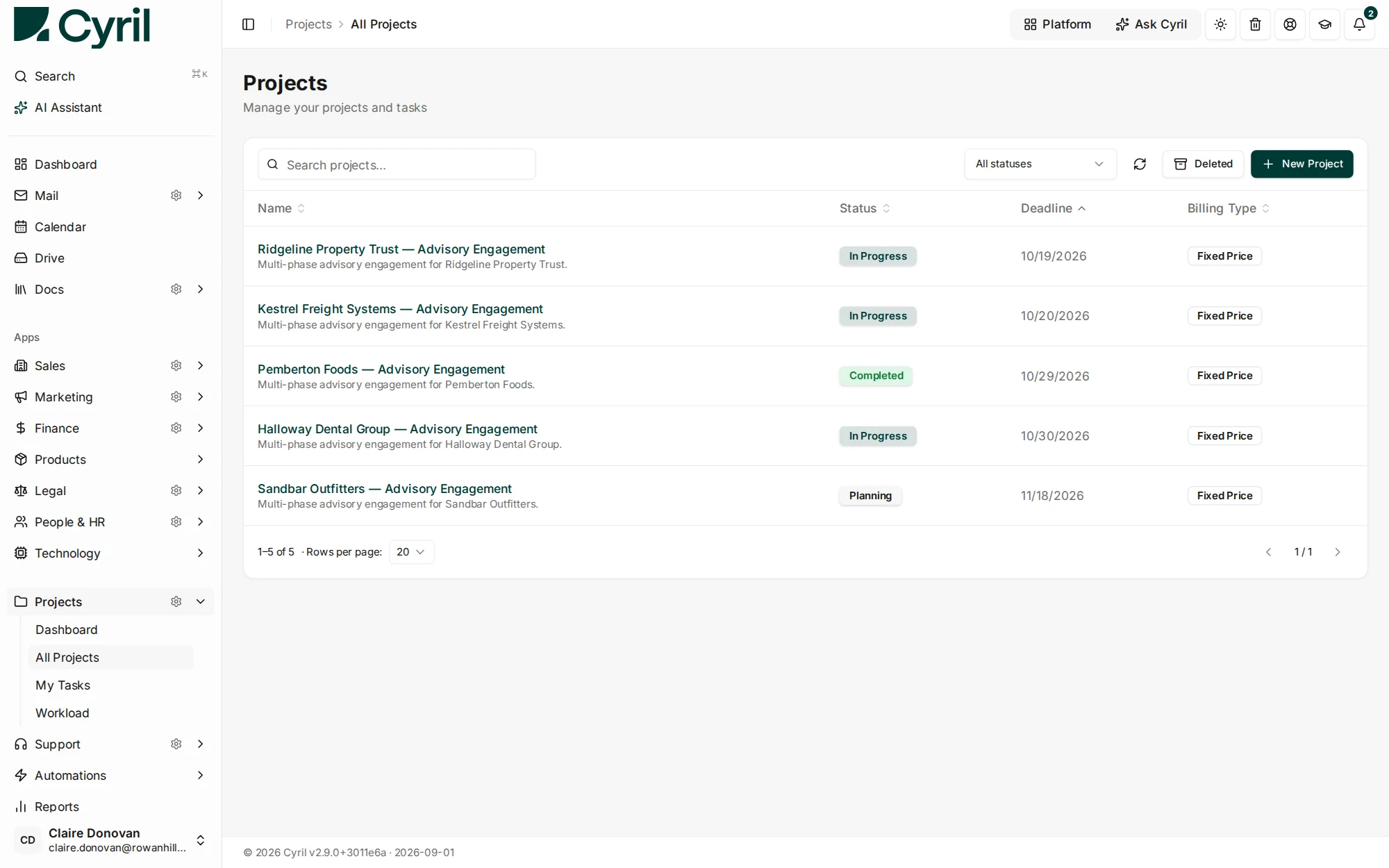
What Projects does for you
Lists, boards, timelines
Same records, different views. Pick the layout your team works best in; the data underneath stays consistent.
Tasks tied to accounts
Every task can roll up to a customer, deal, or support thread. Project context is one click away — and one query for an agent.
Automation built in
Trigger task creation from Sales stage changes, support tickets, or AI agent decisions. Same automation engine across modules.
AI scheduling & triage
Agents draft project plans, route incoming work, and summarise project status — over your real history, not generic templates.
A deal closes. The project starts itself.
Cyril’s automation engine wires Sales stages, project lifecycles, support routing, and financial events into one continuous flow. Same data graph, one rule set.
- Deal won → project created → kickoff scheduled
- Ticket opened → task created → SLA started
- Project milestone → invoice drafted → customer notified
Delivery status is visible where the invoicing happens.
Financials read from projects as well as deals, so "what is shipped" and "what is invoiced" are answerable together rather than reconciled at month end. A task can roll up to a customer, a deal or a support thread, which means the question "is this account in trouble" reaches delivery without anyone exporting anything.
- Projects and invoices on one graph, so margin is current
- Tasks roll up to a customer, a deal or a ticket
- A support escalation can create the task, not a webhook
Common Projects questions
Cyril’s projects module is built to live alongside Sales, support, docs, and financials on one graph. Standalone tools require integration glue to read CRM context; Cyril is the source of truth.
Lists, boards and timelines over the same records, with tasks, dependencies and automation. What it is deliberately not is a standalone product with its own copy of the customer. Resource levelling and critical-path scheduling are thinner than a dedicated PPM tool — if those are your core need, keep the specialist.
Yes. Modules are part of one platform rather than a bundle you assemble, and nothing forces a project to have a deal attached. You lose the cross-module answers this page is about, which is the point of the trade rather than a hidden catch.
Only what you choose to expose through the client portal, which is free and unlimited for customer users. Internal tasks stay internal — visibility runs off the same permission model as everything else, not a separate sharing setting.
Be one of the first to use Cyril.
Join the waitlist for early access. We'll only email you when there's something real to share.